If you've researched melasma treatment at all, you've run into hydroquinone — it's one of the most prescribed and most searched-for melasma ingredients worldwide. It also has a genuinely complicated safety record, and most of what's written about it online is either overly alarmist or doesn't explain the actual mechanism. Here's a straight answer.
What hydroquinone actually does
Hydroquinone works by inhibiting tyrosinase, the enzyme your skin cells use to produce melanin. Less enzyme activity means less new pigment, which is why hydroquinone can visibly lighten melasma patches faster than most alternatives — often within weeks. This is a real, well-documented mechanism, not a myth.
Why it's risky without supervision
- Ochronosis. With prolonged, high-concentration or unsupervised use, hydroquinone can cause a rare but permanent blue-black darkening of the skin — the exact opposite of the intended effect, and very difficult to reverse.
- Rebound hyperpigmentation. Stopping hydroquinone after long-term use can trigger pigment to return, sometimes darker than before treatment started.
- Irritation and sensitization. Hydroquinone can cause redness, stinging and contact dermatitis, especially at higher concentrations or combined with other actives.
- Regulatory restrictions. Several countries restrict or prohibit over-the-counter hydroquinone sale specifically because of the ochronosis risk from unsupervised use — it's intended for short, monitored treatment cycles under professional guidance, not continuous long-term use.
This isn't saying hydroquinone never works
Used correctly — short cycles, appropriate concentration, under a dermatologist's supervision — hydroquinone genuinely helps many people. The real risk comes from unsupervised, continuous, over-the-counter use without a clear stop point, which is unfortunately how it's most commonly used.
The alternative: regulating pigment instead of bleaching it
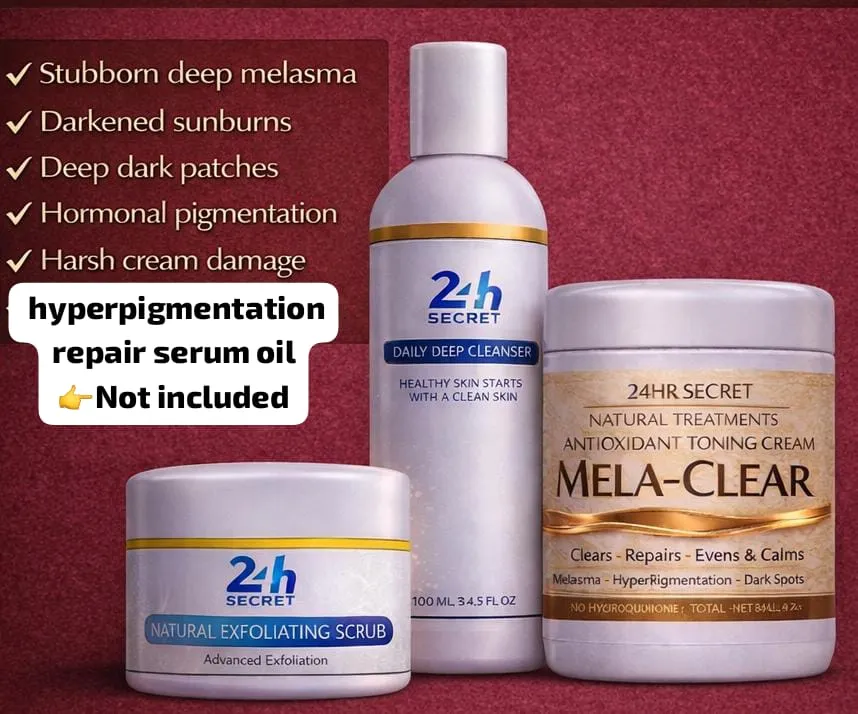
Our approach doesn't inhibit melanin production the way hydroquinone does. Instead, it works on calming overactive pigment cells, lifting pigment that's already built up, and repairing the skin barrier that keeps triggering new pigment — a slower mechanism, but one that doesn't carry hydroquinone's ochronosis or rebound-darkening risk because nothing is being chemically bleached.
The honest trade-off: this typically takes longer to show visible change than hydroquinone's fast fade — our own realistic timeline is 8–10 weeks for full results, not days. What you get in exchange is a routine you can use continuously without the ochronosis or rebound risk that makes long-term hydroquinone use genuinely risky.
If you're already using hydroquinone
Don't stop abruptly without a plan — sudden discontinuation after long-term use is part of what triggers rebound darkening. If you want to transition to a natural routine, message us on WhatsApp for a free skin analysis so we can talk through a sensible transition rather than guessing.